New Research Highlights the Critical Role of Social and Emotional Development
- Two of the latest international meta-analyses show that empathy does not develop through theoretical lessons or imposed rules, but through repeated relational experiences in which children learn to understand their own emotions and respond to the emotions of others.
- “One of the strongest predictors of how a child will develop – in terms of emotional well-being, meaningful relationships, and even success in life – is whether they have had at least one adult who was truly present for them,” says Daniel J. Siegel, one of the world’s leading experts in interpersonal neurobiology and child development, who will return to ParentED Fest for the second consecutive year.
- Research in child development shows that the consistent presence of an emotionally available adult is one of the most important protective factors for a child’s long-term development.
Bucharest, 30 July 2026 – A meta-analysis published in 2024, which examined data from 25,831 children and adolescents, confirms the direct link between emotional regulation and the development of empathy. Another analysis, based on 110 studies, shows that empathy is developed through authentic relationships and repeated social experiences, rather than through theoretical instruction. At a time when Romania is facing major challenges related to children’s mental health and well-being, ParentED Fest 2026 and the Kids Hero Foundation are bringing the latest scientific evidence and some of the world’s leading experts in child development into the spotlight.
According to the latest research in developmental psychology and neuroscience, children’s ability to build healthy relationships, collaborate with others, and manage their emotions is among the most important competencies for the future. While performance is increasingly measured through academic achievement and digital skills, scientific literature indicates that social and emotional development forms the foundation upon which all other competencies are built.
A meta-analysis published in 2024 in the Psychological Bulletin¹, which included 58 studies and data from 25,831 children and adolescents, found a significant association between emotion regulation and empathic and prosocial behaviour. The overall relationship identified by the researchers indicates that children who are better able to regulate their own emotions are also more likely to display behaviours oriented towards helping and supporting others.
These findings are reinforced by a second analysis published in 2024², which synthesised the results of 110 studies on empathy development interventions. The review shows that the most effective approaches are those based on authentic relational experiences and repeated social interactions, rather than simply providing information about empathy. The researchers conclude that empathy develops most effectively when children have opportunities to practise it in real-life relationships: through interactions with parents, teachers and peers, as well as through experiences involving cooperation, active listening and emotional regulation.
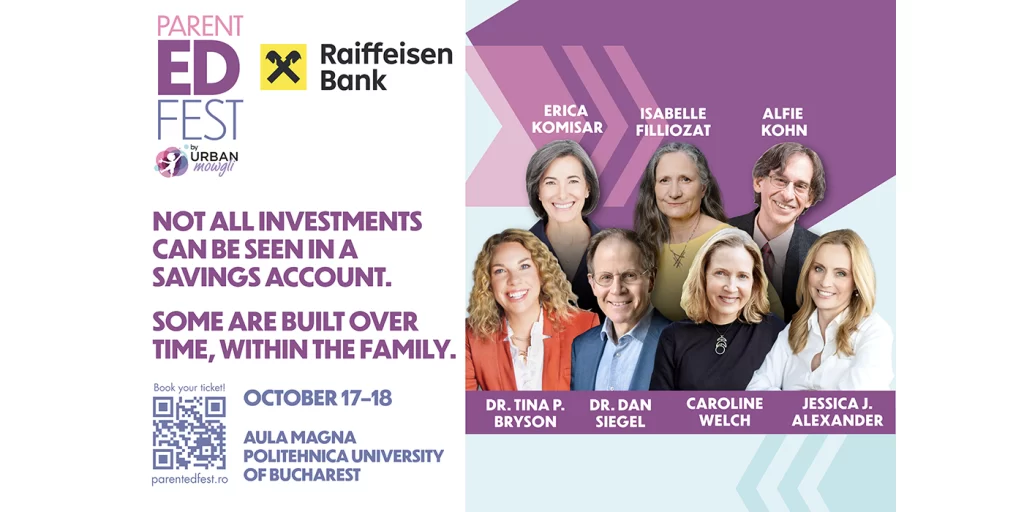
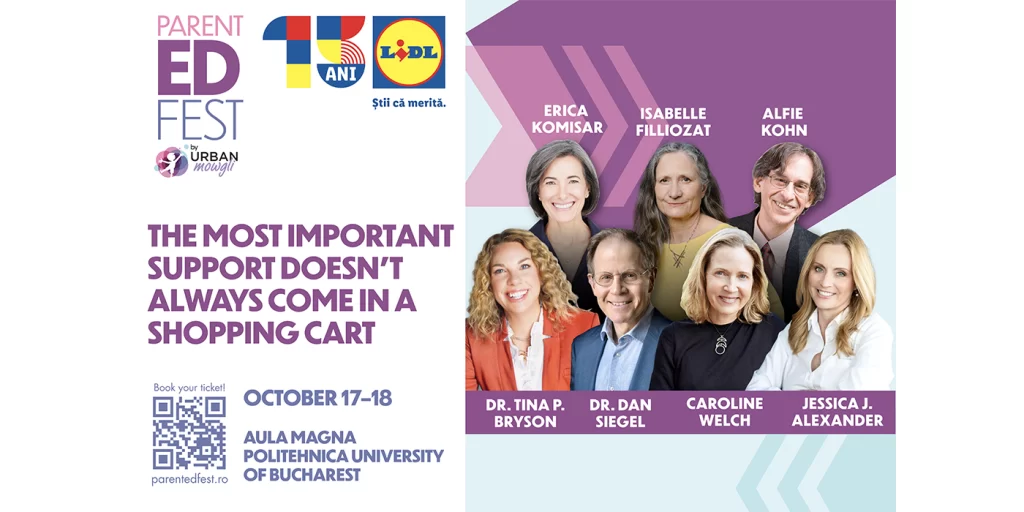
These conclusions are fully aligned with the messages promoted by some of the world’s most influential child development experts, who will be featured at the third edition of the ParentED Fest parenting festival in Bucharest.
Relationships That Shape Development
Research conducted over recent decades shows that early relationships are not merely the context in which children grow up – they are one of the primary mechanisms through which emotional and social capacities are formed.
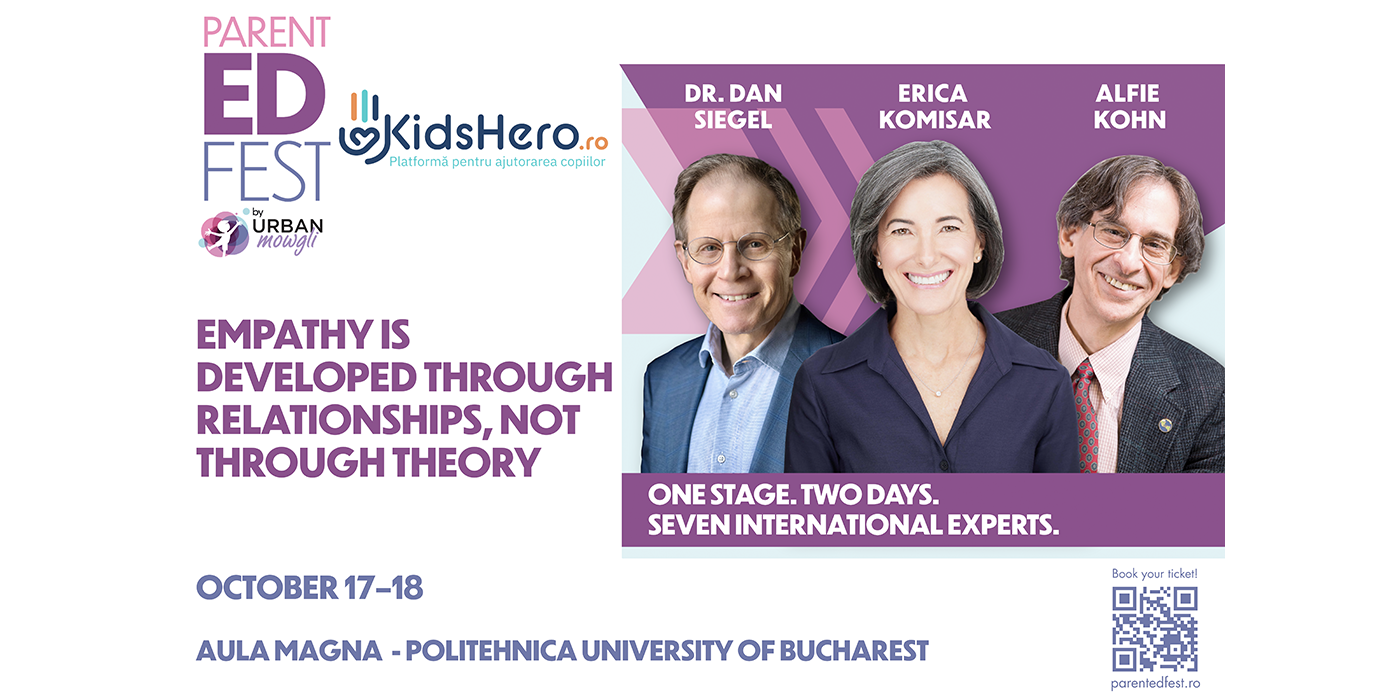
For Dr Dan Siegel, one of the world’s leading experts in interpersonal neurobiology and child development, relationships are the foundation of healthy development: “One of the strongest predictors of how a child will develop – in terms of emotional well-being, meaningful relationships, and even success in life – is whether they have had at least one adult who was truly present for them.” Dr Dan Siegel will return to ParentED Fest for the second time at the 2026 edition.
Research synthesised by the Harvard Center on the Developing Child shows that consistent, responsive interactions between children and caregivers (“serve and return”) contribute to the development of the neural circuits involved in emotion regulation, learning and social connection. Stable relationships act as protective factors against toxic stress and support the development of resilience. ³
This perspective is also supported by longitudinal studies that have followed human development over several decades. The Dunedin Study, one of the world’s best-known human development studies, has tracked approximately 1,000 individuals in New Zealand for more than 50 years and found that levels of self-control observed in childhood are associated with better health outcomes, stronger social integration and greater economic stability later in life.⁴
Emotional Competencies Also Influence Academic Performance
Contrary to the perception that social and emotional skills are separate from academic success, research shows that the two are closely connected.
A large-scale meta-analysis examining 213 programs and 270,034 students found that those who participated in social and emotional learning programs achieved higher academic performance than those who did not, with gains equivalent to an average improvement of 11 percentile points in academic achievement. In addition, participants demonstrated stronger social and emotional competencies and reductions in behavioural problems.⁵
At an international level, the OECD includes emotional regulation, cooperation, empathy, resilience and openness to new experiences among the essential skills for human development. OECD data show that these competencies are associated with better school adjustment, stronger social relationships and higher levels of life satisfaction.⁶
At the same time, the World Health Organization warns that approximately one in seven adolescents aged between 10 and 19 experiences a mental health condition, making prevention and the development of emotional competencies from early childhood a public health priority.⁷
From Behaviour to Human Development
According to Alfie Kohn, American author, lecturer and one of the world’s most influential critics of education based on rewards and punishments, an approach to education focused exclusively on compliance risks limiting the development of children’s moral autonomy: “The more we focus on obedience and compliance, the less we help children develop their own moral judgment.” Alfie Kohn is one of the confirmed speakers at ParentED Fest 2026, where he will deliver a keynote on education centred on cooperation, autonomy and critical thinking.
This perspective is complemented by Erica Komisar, American psychoanalyst, psychotherapist and author, widely recognised for her research and clinical work on attachment, early childhood development and children’s mental health. She emphasises the role of early relationships in preventing emotional difficulties: “Children’s mental health does not begin in adolescence, nor when visible problems first emerge. It begins much earlier, in the first years of life, in the relationship between the child and the adult who cares for them.” Erica Komisar will also join ParentED Fest 2026, where she will explore the importance of secure attachment and the parent-child relationship in fostering healthy emotional development.
The overarching message emerging from current research is clear: child development is not simply about acquiring knowledge or achieving visible performance. It is about developing the ability to understand, regulate and express emotions, build meaningful relationships and participate in society in a healthy and constructive way.
A Shared Vision for the Future
For Diana Bălan, Co-Founder of ParentED Fest, investing in children’s emotional development means investing in the future of society: “Over the past few years, we have invested enormously in what we teach children, but far too little in how we make them feel. Research shows us that relationships are the invisible infrastructure of human development. A child who feels seen, understood and safe develops not only emotional regulation, but also the ability to build healthy relationships.”
For the second consecutive year, ParentED Fest is supported by the Kids Hero Foundation as its Empowerment Partner, strengthening a partnership built around a shared belief: that children’s emotional development is one of the most important investments a society can make.
Through the children and families it supports, the Kids Hero Foundation helps create the conditions in which disadvantaged children can grow up in safety, access education, healthcare and essential support, and have the opportunity to reach their full potential.
At a time when performance is increasingly measured through outcomes and technical skills, recent research is once again drawing attention to the essential role of relationships and early experiences in children’s development. Scientific evidence accumulated over recent years shows that the way children are supported, listened to and cared for during the first years of life shapes how they relate to others and to the world around them. From this perspective, fostering empathy becomes a fundamental component of children’s healthy development and of building stronger, healthier and more connected communities.
ParentED Fest 2026 will take place on 17–18 October 2026 in Bucharest.
- Yavuz, H. M., Colasante, T., Galarneau, E., & Malti, T. (2024). Empathy, Sympathy, and Emotion Regulation: A Meta-Analytic Review. Psychological Bulletin.
- Wu, X., et al. (2024). Categories of Training to Improve Empathy: A Systematic Review and Meta-Analysis. Psychological Bulletin.
- Harvard Center on the Developing Child – Serve and Return.
- Dunedin Multidisciplinary Health and Development Study.
- Durlak, J. A., et al. (2011). The Impact of Enhancing Students’ Social and Emotional Learning: A Meta-Analysis of School-Based Universal Interventions.
- OECD – Survey on Social and Emotional Skills.
- World Health Organization – Adolescent Mental Health.