- A European survey shows that 48% of young people aged 12–17 – including those in Romania – use artificial intelligence apps, and nearly half of them have been instructed by their teachers on how to do so.
- 31% of surveyed students use artificial intelligence apps to receive complete solutions for assignments and homework.
- Globally, 37% of lower secondary school teachers have used AI in their professional activities.
- Joelle Alexander, parenting expert and speaker at ParentED Fest 2026: “We cannot prepare children for the digital world simply by controlling technology. We must prepare them from within: teach them to have the courage to say ‘no’ when something is not right.”.
BUCHAREST, June 12, 2026 – As artificial intelligence becomes increasingly present in students’ lives, international experts are drawing attention to a less visible challenge: the gap between performance and learning. According to the OECD report analyzed by ParentED Fest, generative artificial intelligence tools can help students complete tasks and achieve better short-term results; however, this does not automatically translate into the acquisition of solid knowledge and skills[1].
A European study conducted across 7 countries – including Romania – shows that 48% of young people aged 12 to 17 reported using ChatGPT in 2024. Among them, nearly half were taught to do so by their
OECD specialists warn that excessive outsourcing of the thinking process to artificial intelligence may reduce engagement. According to the official findings of the OECD Digital Education Outlook 2026 report, “overreliance on generative AI tools that provide direct answers may reduce students’ active engagement, improving task performance without corresponding gains in learning.”
When learning outside of school and without direct guidance from teachers, data analyzed by ParentED Fest show that 56% of students use artificial intelligence to obtain useful information for independent study. In addition, 45% of young people use these apps to request detailed explanations of terms and concepts, 31% turn to digital tools to receive complete solutions for assignments and homework, while 29% seek interactive and adaptive content to guide them throughout the learning process. Only 20% of students use the technology for structuring and planning purposes, such as creating a personalized learning plan and monitoring their own progress.
Several studies indicate that although students with access to general-purpose GenAI tools produce higher-quality outputs than their peers, this advantage disappears and sometimes even reverses during examinations, when access to such tools is restricted. By contrast, when integrated into an educational process with clear objectives, GenAI tools can support knowledge development and generate lasting benefits for learning[2].
The report also highlights the role teachers have in a world where AI is becoming increasingly accessible. In 2024, 37% of lower secondary school teachers used artificial intelligence in their professional activities. Furthermore, 57% of lower secondary school teachers agree that artificial intelligence helps create or improve lesson plans. At the same time, 72% of educators believe that artificial intelligence may affect academic integrity by enabling students to submit work as their own.
Preparing Children “from Within” for the Digital Era
In a context where children’s digital footprint is becoming increasingly extensive and difficult to control, the question is no longer whether they will be exposed, but how prepared they are.
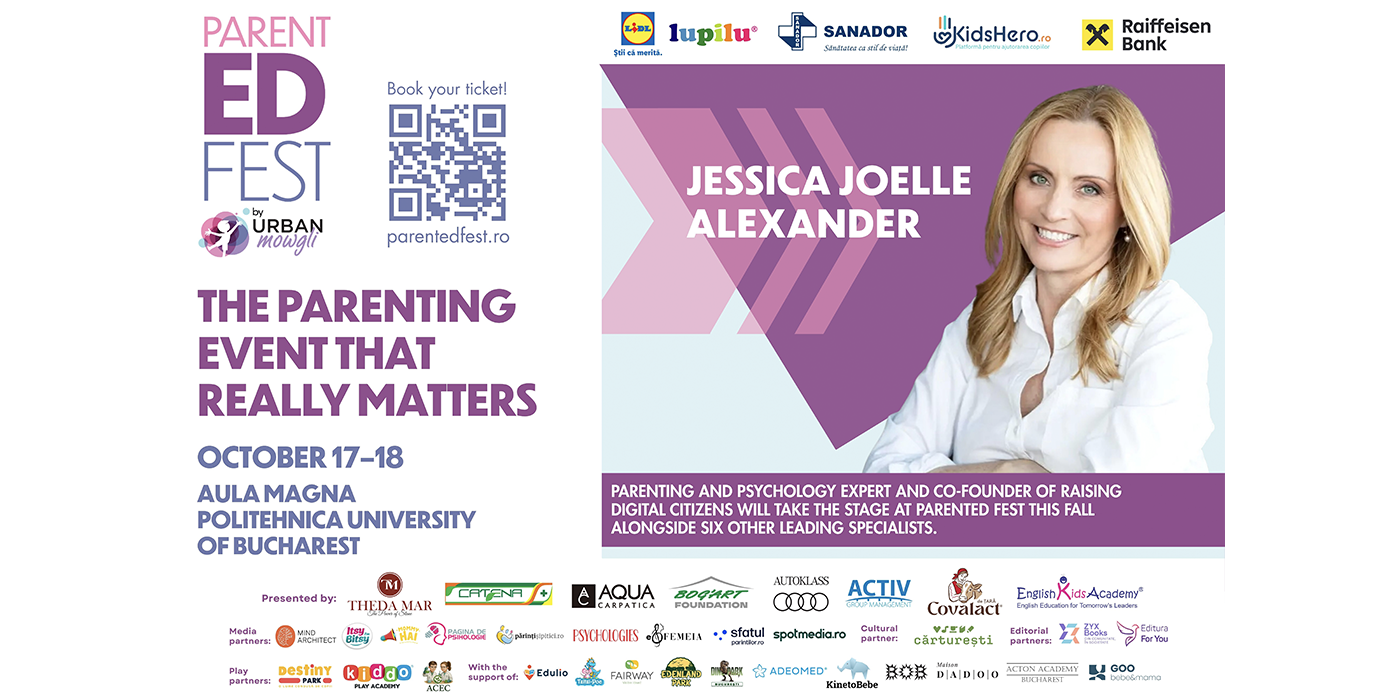
Jessica Joelle Alexander, co-founder of the Raising Digital Citizens platform[3] and one of the keynote speakers at this year’s ParentED Fest, brings to Romania one of the most important topics of the moment: preparing children for a digital world they enter long before they have developed the internal tools needed for protection.
“We cannot prepare children for the digital world simply by controlling technology. We must prepare them from within: to think critically, feel empathetically, and have the courage to say ‘no’ when something is not right. Having ongoing conversations about values in the online world and building a relationship based on trust rather than fear is one of the best long-term investments a family can make for a child’s safety,” says Jessica Joelle Alexander.
This year’s edition of ParentED Fest will take place on October 17–18 and will bring together 7 leading international experts in child psychology and education: Alfie Kohn, Erica Komisar – for the first time in Romania, Kelly McDaniel – for the first time in Romania, Dr. Tina Payne Bryson, Dr. Dan Siegel – returning by popular demand, Caroline Welch, and Jessica Joelle Alexander – returning to ParentED Fest for the second time.
More information about ParentED Fest 2026 is available at www.parentedfest.ro.
Event supported by: Strategic Partner: Lidl Romania / Lupilu, Healthcare Partner: Sanador, Empowerment Partner: Kids Hero Foundation, Growth Partner: Raiffeisen Bank. Supported by: ThedaMar, Catena, Aqua Carpatica, Bog’Art Foundation, Autoklass Audi Ploiești, Activ Group Management, Covalact. Educational Partner: English Kids Academy. Media Partners: Mind Architect, Itsy Bitsy, Mommy Hai, Pagina de Psihologie, Părinți și Pitici, Psychologies, e-femeia, Sfatul Părinților, SpotMedia. Cultural Partner: Carturesti. Editorial Partners: ZYX Books, Editura For You. Play Partners: Destiny Park, Kiddo Play Academy, ACEC. Produced with the support of: Tzitzi Poc, Edulio, Edenland Park, Fairway, Dino Park Bucuresti, Kinetobebe, BOB, Maison Dadoo, Acton Academy Bucharest, Goo – mama&bebe.
[1] OECD Digital Education Outlook 2026